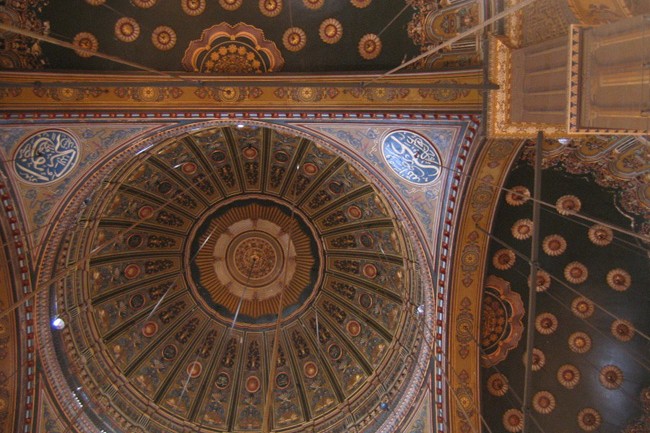
Egypt and Libya, March 19 - April 2, 2006 / 20060324f_MosqueMohammedAliDome
Ruth Milner, rmilner plus web at bookofmarvels dot net
I took this picture
lying down on the floor, so I could look straight up at the
beautifully painted domes of the mosque.
From here we went to the Egyptian Museum,
where Heidi gave us a whirlwind tour, including going in via the back way to
the Tutankhamun exhibit. His nested shrines and gold accoutrements such
as collars, funerary mask, etc. are breathtaking, but what really got
me was some of the everyday items that were also found in his tomb.
These included a folding travel chair, a chest whose hinges closely
resemble modern ones, and a fair number of boomerangs. We'd never
heard before that the ancient Egyptians had boomerangs, but a little
research shows that they date back at least 30,000 years in Europe
and Asia. And I was surprised that the hinge was in common use 4000
years ago, too.
After leaving the museum, we spent a couple
of hours wandering around Khan el-Khalili market. It was packed
as the prayers had just finished and everyone
who had been in the nearby mosques seemed to head straight there.
There were many people carrying trays of goods on their heads, and when
they were coming through the crowd they would make a hissing sound to
get people to move out of their way. Our kids did not enjoy the throng;
Matthew started making the hissing sound himself whenever we were
having trouble moving forward. There were many stalls selling
everything imaginable, and a constant stream of people trying to get us
into their shops (by the time we left Egypt I'm afraid we were very
tired of this). We had a late lunch at a restaurant, and around that
time the effect of the Luxor tabbouli started to make itself known;
it got especially bad during the drive to the airport.
The urgent focus necessary to get us checked in for the flight to
Tripoli helped distract me from the most acute period, but it stayed
with me to varying degrees for weeks. Next time I must remember to take
a larger supply of Imodium, which helped tremendously.